Documentation Mistakes That Delay Fragrance Exports
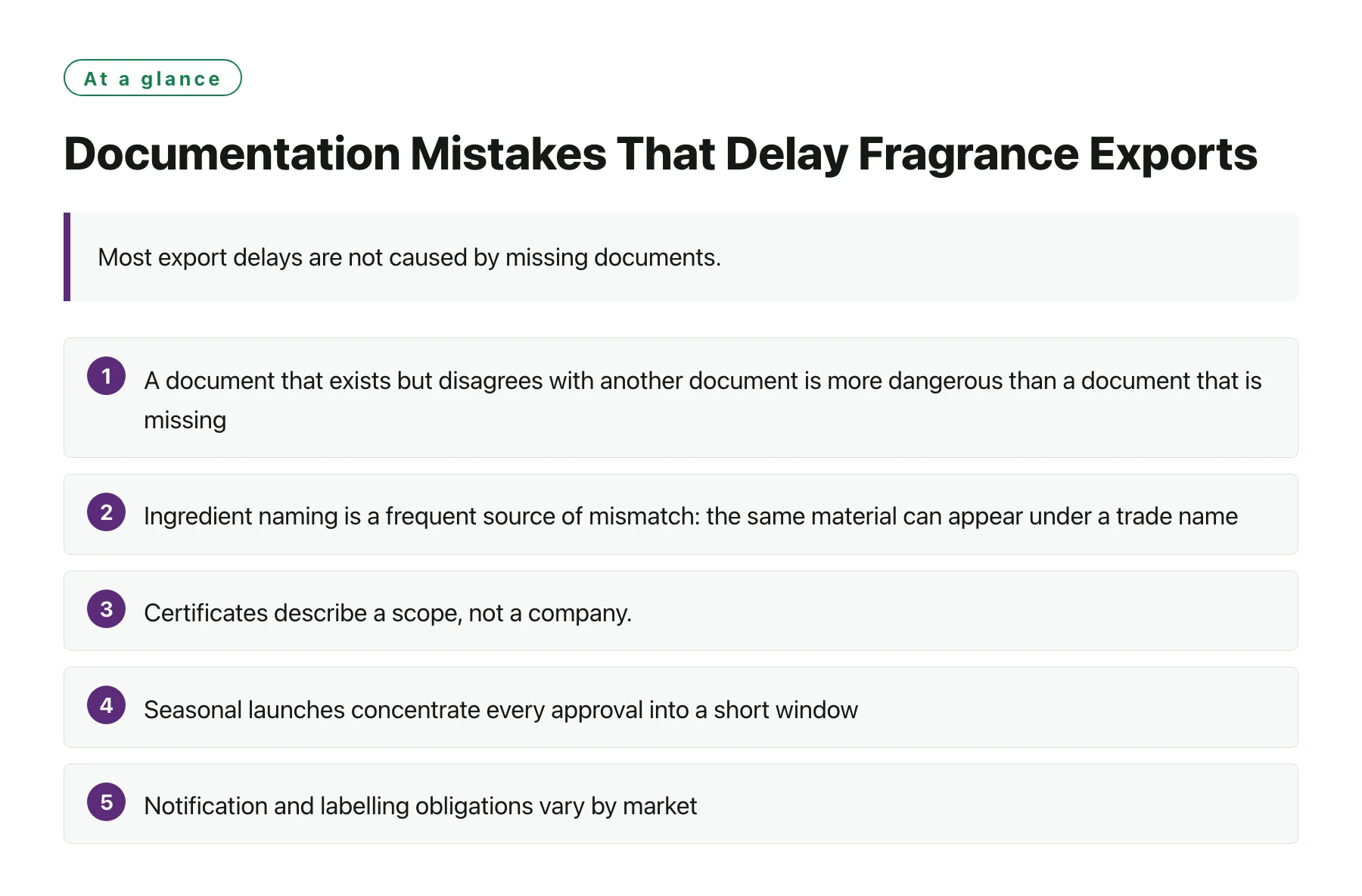
Most export delays are not caused by missing documents. They are caused by documents that exist but do not match: a label that disagrees with the ingredient declaration, a certificate whose scope is narrower than the buyer assumed, a formula reference that changed after the safety file was written. Because these mismatches usually surface late, they are expensive. The countermeasure is unglamorous — decide who checks what, and when — but it removes most of the delay.
Key takeaways
- A document that exists but disagrees with another document is more dangerous than a document that is missing, because the mismatch is only discovered at the port or at the retailer's compliance desk.
- Ingredient naming is a frequent source of mismatch: the same material can appear under a trade name, an INCI name and an internal code, and export paperwork has to reconcile all three [1].
- Certificates describe a scope, not a company. A supplier can hold a genuine certificate that does not cover the process your product depends on.
- Seasonal launches concentrate every approval into a short window, so a single late formula change can invalidate several documents at once.
- Notification and labelling obligations vary by market, and a file built for one destination rarely transfers without amendment [2].
Brands tend to audit their export documentation by asking whether each document exists. That question produces a comfortable answer and hides the actual failure mode, which is disagreement between documents.
The mistakes below are the ones that recur across seasonal projects. None of them requires a specialist to prevent; all of them require somebody to be responsible for consistency.
Mistakes that begin with the brief
The earliest errors are the cheapest to fix and the hardest to notice, because at the brief stage nothing looks wrong yet. One useful habit is to compare your own list against what a manufacturer publishes about its certification and service scope, such as the information set out on Xuelei's official website, because that comparison shows which gaps belong to the factory and which ones are yours.
Treating the factory's standard pack as your document list
A manufacturer's standard pack reflects the markets it ships to most often. It is a good starting inventory and a poor substitute for a market-specific list, because the obligations attach to the destination. A collection headed for one region may need a notification, a local responsible entity, or a labelling format that simply is not in the standard pack.
Leaving the destination market open
Projects that begin with 'we will decide the market later' end up producing documents twice. If the market genuinely cannot be fixed, restrict the brief to the parts that are market-independent — fragrance direction, pack format, fill weight — and hold the label until the destination is known.
Assuming the ingredient data is already agreed
One material may be known to the perfumer by its trade name, to the regulator by its INCI name, and to the factory by an internal code. If those three labels are never reconciled in a single document, the label, the declaration and the safety file will drift apart. Building a naming table early costs an hour and prevents a reprint [1].
Symptom, cause, and the cheap countermeasure
| Symptom at the port or retailer | Usual cause | Countermeasure that prevents it |
|---|---|---|
| Label wording differs from the safety file | Formula or claims changed after the file was written | Freeze label content before printing and route later changes through one owner |
| Certificate rejected | Scope on the certificate does not cover the process in question | Read the scope statement, not just the certificate title, and keep a copy on file |
| Ingredient list queried | Trade, INCI and internal names were used interchangeably | Maintain one naming table and use it in every document |
| Notification missing | Responsibilities were assumed rather than assigned | List the destination's obligations and name an owner for each before the brief |
| Allergen declaration inconsistent | Data came from an earlier version of the compound | Request an updated declaration at the same time as the conformity statement |
| Shipment held for an unsigned document | The signatory is on leave or not identified | Name a named signatory and a deputy in advance, with their contact details on the file |
The pattern in the third column is that every countermeasure is administrative. None of them requires new testing; they require one person to own consistency across documents.
Mistakes that only show up at shipment
Late-stage errors are more visible and more expensive, largely because the product already exists.
The formula moved after the file was signed
A small adjustment late in development — a dosage change, a supplier substitution, a colour correction — can invalidate a safety assessment, an allergen declaration and a conformity statement simultaneously. Any change after the freeze point should trigger an explicit review of the document set, not a silent update [2].
Nobody owns the artwork proof
The factory prints what the brand approves, and the brand approves what marketing sends. When those three steps have no single owner, a legally significant detail — a claim, a symbol, a volume statement — can be lost in a proof cycle. A brand running private label perfume production in China rather than its own formulation often has the thinnest approval trail, precisely because the pack is being adapted from a standard rather than designed from scratch.
The shipment file is treated as an afterthought
Commercial documents are usually handled by a forwarder, which is exactly why nobody in the brand team checks that the description of goods matches the label. A mismatch between the invoice description and the product name on the pack is a customs question rather than a compliance question, but it delays the same container.
One habit removes most of these errors: keep a single document index for the project, with columns for owner, version date and the source of the underlying data. When two documents disagree, the index shows which of them is stale. For a private label line, the same index doubles as the record a buyer will ask for later, so maintaining it is not overhead.
Where to look first if you inherit a messy file
Brands that take over an existing product range, or switch manufacturers, inherit documentation rather than create it. The fastest way to find the weak points is to work backwards from the label, because the label is the document a regulator or retailer can check without asking anyone.
Compare the label against the ingredient declaration, then the declaration against the safety file, then the safety file against the formula reference held by the compounder. Any break in that chain is where a delay will appear. Once the chain holds, the remaining work is administrative and predictable.
It also helps to understand the production stages the documents describe, since a file that does not match how the product is actually made will always be harder to keep consistent. A walk-through of the stages of perfume production usually reveals which documents were written from assumptions rather than from the process itself.
Sources
- EU CosIng — Cosmetic Ingredient Database (European Commission) —— The European Commission's CosIng database of cosmetic ingredients, listing ingredient functions, restrictions and labelling requirements under EU cosmetics law.
- Health Canada: Cosmetic Safety —— Health Canada's cosmetics pages, covering cosmetic notification, the ingredient hotlist and safety requirements for cosmetics sold in Canada.
Frequently asked questions
What is the most common documentation mistake in fragrance exports?
A mismatch between documents that all exist: the label, the ingredient declaration and the safety file describing slightly different versions of the same product. It is common because each document is produced by a different party, and rare is the project where one person checks them against each other.
Does a supplier's certificate remove the need for our own documents?
No. Certificates evidence a management system within a defined scope; they do not transfer the brand's obligation to place a compliant product on the market. They are useful evidence inside your file, but they do not replace the safety assessment or the label checks.
How do we handle a formula change after approval?
Treat it as a documented event. Reconfirm the conformity statement, the allergen declaration and the safety assessment against the new formula, and check whether packaging artwork is affected. Silent updates are how a compliant file becomes a non-compliant one.
Can we prepare the label before the destination market is fixed?
Only the market-independent parts. Claim wording, ingredient presentation and required symbols change between markets, so a label designed for one destination often cannot be transferred without amendment. Freeze the pack format and settle the wording later.
Who should own the document index?
One named person inside the brand, with a deputy, rather than the factory or the forwarder. Both of those parties supply documents, but neither of them can see the whole file, and the whole file is where inconsistencies are found.