Private Label Foundation: Shade Range and Texture Decisions
A foundation launch succeeds or fails as a range, not as a single bottle. A shade ladder that stops at the wrong point, or a texture that only suits one skin type, will cap the product no matter how good the hero shade looks. Yunmei, working as an OEM/ODM partner, publishes 10,000+ mature formulas and 87 patents, including 23 inventions, which is the depth a shade ladder draws on.
Key takeaways
- A foundation is a range decision before it is a single formula.
- The client lists liquid foundation with light to thick textures and rich shade numbers, plus air cushion BB cream.
- Development depth reaches past 10,000 mature formulas, supported by 87 patents including 23 inventions.
- The published per-product floor ranges from 1,000 to 5,000 units, with a 500-unit option for a first order.
Foundation is a range decision
Every other colour category can launch with a small set and grow. Foundation cannot, because a customer who cannot find a match does not buy a second-best shade and stay. The ladder has to open wide enough to cover the target market on day one, and that decision drives the number of base variants, the sampling load and the order size.
That is why the foundation brief is really a range brief. The questions are how many shades, how many textures under those shades, and which skin tones the range can honestly claim. Answering those three before the first sample round saves the cost of rebuilding the ladder later.
Building a shade ladder that sells
A useful ladder is built on depth and undertone together, not on a single hue line. The client's foundation pages cover liquid foundation with light to thick textures, strong concealing power and rich shade numbers, and the buying guide walks through what to weigh before ordering. For a new range, mapping the market's undertone split matters as much as the total shade count.
Gaps show up at the ends of the ladder. A range that is deep in the middle and thin at the lightest and deepest tones will look balanced in a grid and fail on skin. Sample the ends first, then fill the middle, because the extremes are where a customer decides the range is not for them. A short second round on the two ends usually confirms whether the ladder is closed or still open.
Texture: coverage against weight
Texture is a trade the customer feels within an hour. A light texture spreads easily and reads natural, but hides less. A thick texture conceals strongly and holds a matte finish, but can look heavy by mid-afternoon. Medium textures try to sit between the two and are the volume choice for most ranges.
Running two textures under one shade ladder is common, but each texture is a separate base and a separate fill. That doubling is where a plan to build a private label foundation range gets expensive, so the texture count should be a deliberate decision rather than a default of covering everything.
Liquid, cushion and the format question
Liquid and cushion are two ways to deliver the same coverage philosophy. A liquid foundation in a pump suits a controlled, buildable application, while an air cushion BB cream suits a lighter, quicker routine and a refillable pack. The client's pages list both, so a range can carry one shade ladder in two formats if the market splits that way.
The format also changes the pack, the fill line and the unit cost. A cushion adds a sponge and a case, while a liquid adds a pump and a bottle. Deciding the format before the ladder is fixed avoids reworking the shade set for a pack that cannot hold it.
| Texture | Coverage | Where it fits |
|---|---|---|
| Light | Sheer to buildable | Daily wear, natural finish |
| Medium | Balanced | Volume choice for most ranges |
| Full | Strong conceal | Even tone, longer wear |
| Cushion BB | Light, quick | Refillable, on-the-go routine |
Worked example: reading the formula library chart
The chart shows the library divided by 1,000 so it fits the axis, which means ten units stand for 10 × 1,000 = 10,000 formulas. Against a 12-shade ladder, that is 10,000 ÷ 12 ≈ 833 candidate formulas behind each shade. Run two textures per shade and the count becomes 12 × 2 = 24 base variants, so 10,000 ÷ 24 ≈ 416 formulas behind each variant. The patent bar sits at 87, with 23 inventions, which is 23 ÷ 87 ≈ 0.26, or roughly one in four.
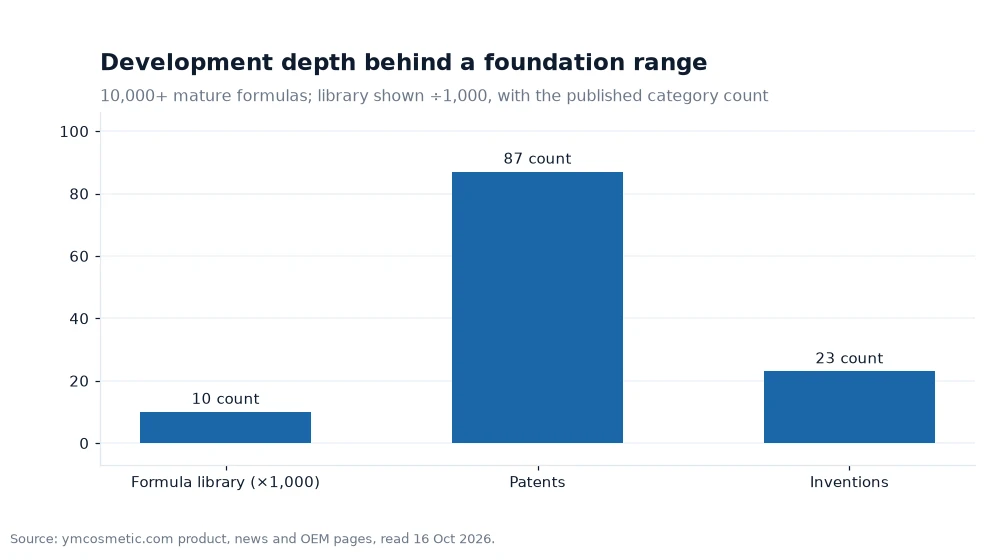
The two figures that frame the decision are 10,000 and 24. A library that size means a ladder is assembled from existing work rather than written from scratch, while the 24 variants from a two-texture, twelve-shade plan show how quickly a modest range multiplies the formula count the factory has to manage.
Skin-care ingredients in a colour product
Foundation is now read as part skin care. The client's pages mention a skin-nourishing liquid foundation direction with hyaluronic acid and vitamin E, which is the kind of addition that lets a colour product carry a comfort story as well as a coverage story. It also adds a claim to substantiate, so the test plan has to include it.
Adding an active is not free. It can change the feel, the stability and the shade over time, so it belongs in the formula review rather than in the marketing brief alone. Testing the nourishing version beside the plain version keeps the comparison honest and protects the launch date.
Sampling a shade ladder without doubling the order
A ladder does not need a full-unit sample for every shade. Early rounds can compare drawdowns and small fills, with full units reserved for the shades that survive. That keeps the sampling bill and the review time under control while still giving the range enough coverage to judge.
Once the ladder is set, the order splits into shades, and the per-product minimum applies to each. A twelve-shade range at the low end is 12 × 1,000 = 12,000 units, which is the number to sanity-check before finalising. Phasing the launch, with the core shades first and the extremes a season later, is one way to keep that total within reach while the range proves itself. The makeup manufacturing range shows how the other categories scale beside foundation.
Frequently asked questions
Why is foundation treated as a range?
Because a customer who cannot find a match rarely buys a substitute shade and stays. The ladder has to open wide enough on day one, which drives the base variants, the sampling load and the order size.
How many textures should a first range carry?
Two is common, but each texture is a separate base and a separate fill. A twelve-shade ladder with two textures becomes 24 base variants, so the texture count should be a deliberate decision.
Can foundation carry skin-care ingredients?
The client's pages mention a skin-nourishing liquid foundation direction with hyaluronic acid and vitamin E. Any added active has to be tested for feel, stability and shade, so it belongs in the formula review.
Setting the shade ladder before the order
Fix the shade count, the undertone split and the texture count in that order, and the ladder stops growing once the order is placed. From there, sample the ends before the middle and reserve full units for the shades that survive. A partner that already holds a deep library can fill the gaps faster than one starting from a blank page, which is the real reason to compare development depth on the OEM and ODM services page before choosing a route.
Every capacity and timing figure above is quoted from the manufacturer's public pages, read 16 Oct 2026.[1]